
Swindon Landfill Waste and Recycling Statistics 2025

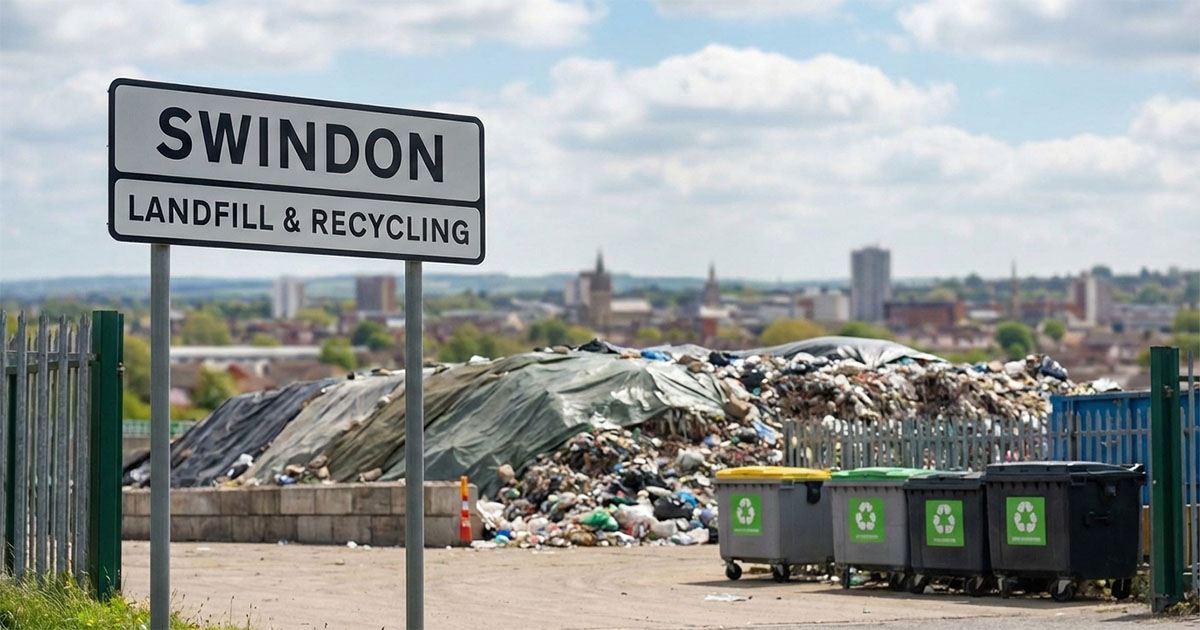
With around 100,000 households and one of the largest areas in Wiltshire, Swindon faces an ongoing challenge to manage waste in a more sustainable way. In this report, we look at how Swindon’s waste and recycling figures compare with the rest of the country and how Swindon Borough Council plans to tackle these issues through its sustainability strategy, which sets goals up to 2029.
How much waste does Swindon generate?
The latest government data and Swindon’s waste strategy show that for the year ending March 2024:
- Swindon’s waste services collected 96,760 tonnes of waste — roughly the weight of 645 blue whales!
- 92% of this waste came from households (88,681 tonnes).
- The average Swindon resident produces 365.7 kg of household waste each year, slightly higher than the national average of 363.7 kg.
- Only 33.8% of Swindon’s household waste was recycled, reused or composted.
- To put this in content, this recycling rate places Swindon third from the bottom in the South West, just ahead of Plymouth (32.9%) and Exeter (29.1%).
How do Swindon’s waste and recycling statistics compare to other areas?
Local authorities are under increasing pressure to limit the environmental impact of landfill by finding better ways to handle household waste. Swindon is no exception — but how does it measure up against other areas in the South West and the rest of England?
- Out of England’s 321 local authorities, Swindon ranked 104th for total waste collected (96,760 tonnes) in the year to March 2024 — roughly mid-table.
- By comparison, Greater Manchester tops the list, producing more than 1 million tonnes (1,074,766 tonnes), over ten times Swindon’s figure.
- Within the South West, Swindon sits 11th out of 28, behind counties like Devon (363,895 tonnes) and Gloucestershire (288,847 tonnes).
When it comes to recycling:
- Swindon’s recycling rate remains below the national average of 42.3% and well below Dorset’s leading 60.5% in the region.
- Since 2020, Swindon’s recycling performance has slipped, while the amount of household waste has stayed high, with some variation year to year.
How much of Swindon’s waste is sent to landfill?
According to recent government data:
- In the year ending March 2024, 174 tonnes of waste was sent to landfill — down from 739 tonnes the previous year.
- Over the last four years, Swindon has cut landfilled waste by 98%, from 8,543 tonnes in 2020 to just 174 tonnes in 2024.
- Meanwhile, waste incinerated to generate energy has increased by 109%, rising from 29,246 tonnes in 2020 to 61,204 tonnes in 2024.
Other concerning landfill waste statistics for Swindon
A 2025 analysis of Swindon’s household bins has revealed that thousands of tonnes of recyclable materials and food waste are still being thrown away in black wheelie bins, costing local households an estimated £2 million each year.
There has been clear progress, especially with food waste. In 2023, food waste made up 38% of the contents of Swindon’s black bins. By 2024, this had dropped to 28%, largely due to the Council’s new food waste collection service, launched in November 2023. In its first year alone, the service diverted 5,280 tonnes of food waste for recycling instead of incineration.
Despite this improvement, food waste that isn’t sorted correctly still ends up in the residual waste stream, costing residents £150 per tonne to incinerate.
The analysis also found that:
- Only 45% of plastics are being recycled properly
- 55% of cans make it into recycling bins
- Alarmingly, 40% of recyclable materials still end up in black bins by mistake
Altogether, this means about £2 million worth of recyclables are being burnt instead of reused.
Swindon’s next steps to a sustainable future
Despite annual volumes of collected waste, Swindon Borough Council is actively pursuing strategies to reduce landfill dependency and improve household recycling. By 2029, the council aims to cut landfill waste to less than 2% of collected waste and reach a 60% recycling rate. Their 10-year Waste Strategy, which launched in 2019, also set out their goals for sustainable waste management including:
- Mandatory recycling of paper, card, tins, glass, and aerosols
- Separate food waste collections
- Phasing out single-use plastics in council buildings
- Updated waste planning guidance to ensure new housing developments support recycling
- Community campaigns such as #RefillSwindon and #ScrapFlyTipping to promote responsible habits
Residents and businesses play a crucial role in hitting these targets. Simple steps — like cutting back on single-use plastics, shopping at Swindon’s zero-waste stores, and recycling correctly — help push local recycling figures in the right direction and reduce unnecessary waste.
If you’re seeking a straightforward, eco-conscious way to clear large volumes of household or commercial waste in Swindon, our skip hire service is a hassle-free choice. For smaller clear-outs, our fully recyclable HIPPOBAGs or convenient Man and Van rubbish removal service are ideal alternatives.